REQUEST AN APPOINTMENT OR BOOK A CONSULANT – Sargam.dange.18@gmail.com
- Developments in Behaviourism (Watson),
- Neo-behavouristic traditions(Skinner),
- Cognitive revolution- A Paradigm Shift)
Positivism is the term used to describe an approach to the study of society that relies specifically on scientific evidence, such as experiments and statistics, to reveal a true nature of how society operates. The term originated in the 19th century, when Auguste Comte described his ideas in his books The Course in Positive Philosophy and A General View of Positivism.
First and foremost, Comte was interested in establishing theories that could be tested with the ultimate goal of improving our world once these theories were clearly laid out. He was eager to discover natural laws that applied to society. He viewed the natural sciences, such as biology and physics, as a necessary step in the development of a social science. Just as gravity is a universal truth we all experience in the physical world, Comte believed sociologists could uncover similar laws operating on the social level of people’s lives.
Two influential positivists include Comte, who coined the term ‘positivism,’ and Emile Durkheim, who established the academic discipline of sociology. These early thinkers laid the groundwork for a social science to develop that they believed would have a unique place among the sciences. This new field would be distinct and have its own set of scientific facts. Comte hoped sociology would become the ‘queen science’ that held more importance than the other natural sciences that had come before it.
Theories of Positivism
Imagine you are a researcher living in France during Comte’s time, in the mid-1800s, interested in studying the choices and structures of your society. European culture around you has dramatically shifted in the past hundred years, with the Enlightenment bringing new focus on the scientific method and logic.
You’re convinced that you and your colleagues live in a time of great promise, having departed in many ways from the more superstitious views of the past. You thirst for the search for knowledge and universal truths. You believe a new era is dawning, one in which a logical approach to the study of society can bring dramatic insights never before explored or understood. You believe you have the potential to play a role in changing the course of human history.
If you felt this way, you would share much in common with the views of Comte, who was excited about the possibility of entering what he saw as the third and final of three key cultural stages. Society had already experienced the first two stages. First, the theological-military stage had been dominant, in which a belief in supernatural beings, slavery, and the military were key elements. Secondly, human culture experienced the metaphysical-judicial stage, in which a great focus on political and legal structures developed as society became more scientific. The final stage would be the scientific-industrial society with a positive philosophy of science emerging due to advances in logical ways of thinking and scientific inquiry.
While positivism formed the basis for sociology, the idea that there is one true set of natural laws governing how society operates is no longer part of mainstream theories. Instead, sociologists recognize that the study of culture is complex and a variety of methods can be used to understand it. For instance, using fieldwork, a researcher can spend time in another culture to learn about it. Modern-day sociologists do not see the development of one ‘true’ vision of society as a goal for sociology as Comte did.
Developments in Behaviourism / behaviourist psychology
Emerging in contrast to psychodynamic psychology, behaviourism focuses on observable behaviour as a means to studying the human psyche. The primary tenet of behaviourism is that psychology should concern itself with the observable behaviour of people and animals, not with unobservable events that take place in their minds. The behaviourists criticized the mentalists for their inability to demonstrate empirical evidence to support their claims. The behaviourist school of thought maintains that behaviours can be described scientifically without recourse either to internal physiological events or to hypothetical constructs such as thoughts and beliefs, making behaviour a more productive area of focus for understanding human or animal psychology.
The main influences of behaviourist psychology were Ivan Pavlov (1849-1936), who investigated classical conditioning though often disagreeing with behaviourism or behaviourists; Edward Lee Thorndike (1874-1949), who introduced the concept of reinforcement and was the first to apply psychological principles to learning; John B. Watson (1878-1958), who rejected introspective methods and sought to restrict psychology to experimental methods; and B.F. Skinner (1904-1990), who conducted research on operant conditioning.
The first of these, Ivan Pavlov, is known for his work on one important type of learning, classical conditioning. As we learn, we alter the way we perceive our environment, the way we interpret the incoming stimuli, and therefore the way we interact, or behave. Pavlov, a Russian physiologist, actually discovered classical conditioning accidentally while doing research on the digestive patterns in dogs. During his experiments, he would put meat powder in the mouth of a dog who had tubes inserted into various organs to measure bodily responses. Pavlov discovered that the dog began to salivate before the meat powder was presented to it. Soon the dog began to salivate as soon as the person feeding it entered the room. Pavlov quickly began to gain interest in this phenomenon and abandoned his digestion research in favour of his now famous classical conditioning study.
Basically, Pavlov’s findings support the idea that we develop responses to certain stimuli that are not naturally occurring. When we touch a hot stove, our reflex pulls our hand back. We do this instinctively with no learning involved. The reflex is merely a survival instinct. Pavlov discovered that we make associations that cause us to generalize our response to one stimuli onto a neutral stimuli it is paired with. In other words, hot burner = ouch; stove = burner; therefore, stove = ouch.
In his research with the dogs, Pavlov began pairing a bell sound with the meat powder and found that even when the meat powder was not presented, a dog would eventually begin to salivate after hearing the bell. In this case, since the meat powder naturally results in salivation, these two variables are called the unconditioned stimulus (UCS) and the unconditioned response (UCR), respectively. In the experiment, the bell and salivation are not naturally occurring; the dog is conditioned to respond to the bell. Therefore, the bell is considered the conditioned stimulus (CS), and the salivation to the bell, the conditioned response (CR).
Many of our behaviours today are shaped by the pairing of stimuli. The smell of a cologne, the sound of a certain song, or the occurrence of a specific day of the year can trigger distinct memories, emotions, and associations. When we make these types of associations, we are experiencingclassical conditioning.
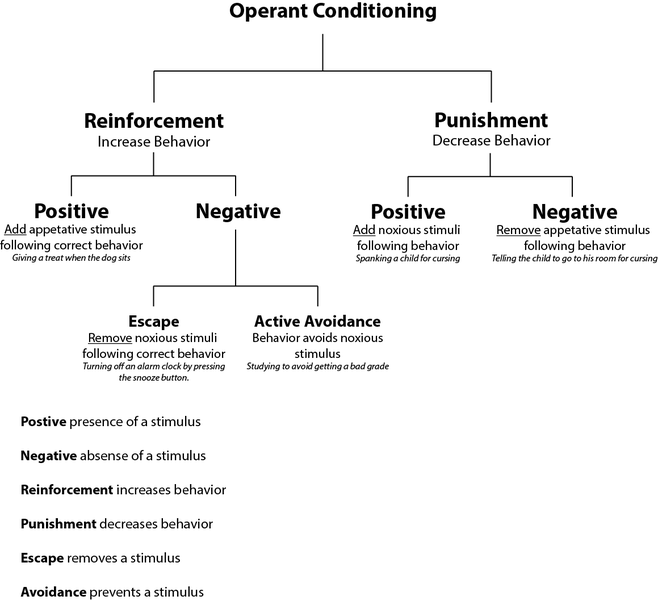
Operant conditioning is another type of learning that refers to how an organism operates on the environment or how it responds to what is presented to it in the environment (Figure 2.12).
REQUEST AN APPOINTMENT OR BOOK A CONSULANT – Sargam.dange.18@gmail.com
Examples of operant conditioning include the following:
Reinforcement means to strengthen, and is used in psychology to refer to any stimulus which strengthens or increases the probability of a specific response. For example, if you want your dog to sit on command, you may give him a treat every time he sits for you. The dog will eventually come to understand that sitting when told to will result in a treat. This treat is reinforcing the behaviour because the dog likes it and will result in him sitting when instructed to do so. There are four types of reinforcement: positive, negative, punishment, and extinction.
- Positive reinforcement involves adding something in order to increase a response. For example, adding a treat will increase the response of sitting; adding praise will increase the chances of your child cleaning his or her room. The most common types of positive reinforcement are praise and reward, and most of us have experienced this as both the giver and receiver.
- Negative reinforcement involves taking something negative away in order to increase a response. Imagine a teenager who is nagged by his parents to take out the garbage week after week. After complaining to his friends about the nagging, he finally one day performs the task and, to his amazement, the nagging stops. The elimination of this negative stimulus is reinforcing and will likely increase the chances that he will take out the garbage next week.
- Punishment refers to adding something aversive in order to decrease a behaviour. The most common example of this is disciplining (e.g., spanking) a child for misbehaving. The child begins to associate being punished with the negative behaviour. The child does not like the punishment and, therefore, to avoid it, he or she will stop behaving in that manner.
- Extinction involves removing something in order to decrease a behaviour. By having something taken away, a response is decreased.
Research has found positive reinforcement is the most powerful of any of these types of operant conditioning responses. Adding a positive to increase a response not only works better, but allows both parties to focus on the positive aspects of the situation. Punishment, when applied immediately following the negative behaviour, can be effective, but results in extinction when it is not applied consistently. Punishment can also invoke other negative responses such as anger and resentment.
Thorndike’s (1898) work with cats and puzzle boxes illustrates the concept of conditioning. The puzzle boxes were approximately 50 cm long, 38 cm wide, and 30 cm tall (Figure 2.13). Thorndike’s puzzle boxes were built so that the cat, placed inside the box, could escape only if it pressed a bar or pulled a lever, which caused the string attached to the door to lift the weight and open the door. Thorndike measured the time it took the cat to perform the required response (e.g., pulling the lever). Once it had learned the response he gave the cat a reward, usually food.

Thorndike found that once a cat accidentally stepped on the switch, it would then press the switch faster in each succeeding trial inside the puzzle box. By observing and recording how long it took a variety of animals to escape through several trials, Thorndike was able to graph the learning curve (graphed as an S-shape). He observed that most animals had difficulty escaping at first, then began to escape faster and faster with each successive puzzle box trial, and eventually levelled off in their escape times. The learning curve also suggested that different species learned in the same way but at different speeds. His finding was that cats, for instance, consistently showed gradual learning.
From his research with puzzle boxes, Thorndike was able to create his own theory of learning (1932):
- Learning is incremental.
- Learning occurs automatically.
- All animals learn the same way.
- Law of effect. If an association is followed by satisfaction, it will be strengthened, and if it is followed by annoyance, it will be weakened.
- Law of use. The more often an association is used, the stronger it becomes.
- Law of disuse. The longer an association is unused, the weaker it becomes.
- Law of recency. The most recent response is most likely to reoccur.
- Multiple response. An animal will try multiple responses (trial and error) if the first response does not lead to a specific state of affairs.
- Set or attitude. Animals are predisposed to act in a specific way.
- Prepotency of elements. A subject can filter out irrelevant aspects of a problem and focus on and respond to significant elements of a problem.
- Response by analogy. Responses from a related or similar context may be used in a new context.
- Identical elements theory of transfer. The more similar the situations are, the greater the amount of information that will transfer. Similarly, if the situations have nothing in common, information learned in one situation will not be of any value in the other situation.
- Associative shifting. It is possible to shift any response from occurring with one stimulus to occurring with another stimulus. Associative shift maintains that a response is first made to situation A, then to AB, and then finally to B, thus shifting a response from one condition to another by associating it with that condition.
- Law of readiness. A quality in responses and connections that results in readiness to act. Behaviour and learning are influenced by the readiness or unreadiness of responses, as well as by their strength.
- Identifiability. Identification or placement of a situation is a first response of the nervous system, which can recognize it. Then connections may be made to one another or to another response, and these connections depend on the original identification. Therefore, a large amount of learning is made up of changes in the identifiability of situations.
- Availability. The ease of getting a specific response. For example, it would be easier for a person to learn to touch his or her nose or mouth with closed eyes than it would be to draw a line five inches long with closed eyes.
John B. Watson promoted a change in psychology through his address, Psychology as the Behaviorist Views It (1913), delivered at Columbia University. Through his behaviourist approach, Watson conducted research on animal behaviour, child rearing, and advertising while gaining notoriety for the controversial “Little Albert” experiment. Immortalized in introductory psychology textbooks, this experiment set out to show how the recently discovered principles of classical conditioning could be applied to condition fear of a white rat into Little Albert, an 11-month-old boy. Watson and Rayner (1920) first presented to the boy a white rat and observed that the boy was not afraid. Next they presented him with a white rat and then clanged an iron rod. Little Albert responded by crying. This second presentation was repeated several times. Finally, Watson and Rayner presented the white rat by itself and the boy showed fear. Later, in an attempt to see if the fear transferred to other objects, Watson presented Little Albert with a rabbit, a dog, and a fur coat. He cried at the sight of all of them. This study demonstrated how emotions could become conditioned responses.
Burrhus Frederic Skinner called his particular brand of behaviourism radical behaviourism (1974). Radical behaviourism is the philosophy of the science of behaviour. It seeks to understand behaviour as a function of environmental histories of reinforcing consequences. This applied behaviourism does not accept private events such as thinking, perceptions, and unobservable emotions in a causal account of an organism’s behaviour.
While a researcher at Harvard, Skinner invented the operant conditioning chamber, popularly referred to as the Skinner box (Figure 2.14), used to measure responses of organisms (most often rats and pigeons) and their orderly interactions with the environment. The box had a lever and a food tray, and a hungry rat inside the box could get food delivered to the tray by pressing the lever. Skinner observed that when a rat was first put into the box, it would wander around, sniffing and exploring, and would usually press the bar by accident, at which point a food pellet would drop into the tray. After that happened, the rate of bar pressing would increase dramatically and remain high until the rat was no longer hungry.
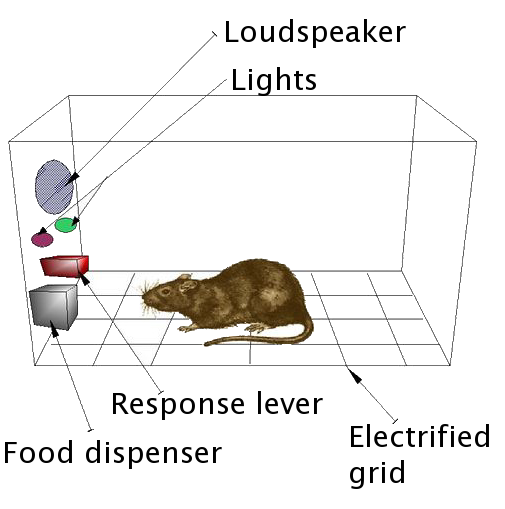
Negative reinforcement was also exemplified by Skinner placing rats into an electrified chamber that delivered unpleasant shocks. Levers to cut the power were placed inside these boxes. By running a current through the box, Skinner noticed that the rats, after accidentally pressing the lever in a frantic bid to escape, quickly learned the effects of the lever and consequently used this knowledge to stop the currents both during and prior to electrical shock. These two learned responses are known as escape learning and avoidance learning (Skinner, 1938). The operant chamber for pigeons involved a plastic disk in which the pigeon pecked in order to open a drawer filled with grain. The Skinner box led to the principle of reinforcement, which is the probability of something occurring based on the consequences of a behaviour.
Impact and aftermath of the cognitive revolution
By the early 1960s the relevance of the Skinnerian approach for understanding complex mental processes was seriously questioned. The linguist Noam Chomsky’s critical review of Skinner’s theory of “verbal behaviour” in 1959 showed that it could not properly account for human language acquisition. It was one of several triggers for a paradigm shift that by the mid-1960s became the “cognitive revolution,” which compellingly argued against behaviourism and led to the development of cognitive science. In conjunction with concurrent analyses and advances in areas from computer science and artificial intelligence to neuroscience, genetics, and applications of evolutionary theory, the scientific study of the mind and mental activity quickly became the foundation for much of the evolving new psychological science in the 21st century.
Psychological scientists demonstrated that organisms have innate dispositions and that human brains are distinctively prepared for diverse higher-level mental activities, from language acquisition to mathematics, as well as space perception, thinking, and memory. They also developed and tested diverse theoretical models for conceptualizing mental representations in complex information processing conducted at multiple levels of awareness. They asked such questions as: How does the individual’s stored knowledge give rise to the patterns or networks of mental representations activated at a particular time? How is memory organized? In a related direction, the analysis of visual perception took increasing account of how the features of the environment (e.g., the objects, places, and other animals in one’s world) provide information, the perception of which is vital for the organism’s survival. Consequently, information about the possibilities and dangers of the environment, on the one side, and the animal’s dispositions and adaptation efforts, on the other, become inseparable: their interactions become the focus of research and theory building.
Traditional personality-trait taxonomies continued to describe individuals and types using such terms as introversion-extraversion and sociable-hostile, based on broad trait ratings. In new directions, consistent with developments in cognitive science and social psychology, individual differences were reconceptualized in terms of cognitive social variables, such as people’s constructs (encoding of information), personal goals and beliefs, and competencies and skills. Research examined the nature of the consistencies and variability that characterize individuals distinctively across situations and over time and began to identify how different types of individuals respond to different types of psychological situations. The often surprising findings led to new models of cognitive and affective information-processing systems.
In clinical applications, cognitive-behaviour therapy (CBT) was developed. CBT focuses on identifying and changing negative, inaccurate, or otherwise maladaptive beliefs and thought patterns through a combination of cognitive and behaviour therapy. It helps people to change how they think and feel about themselves and others. In time, these cognitive-behavioral treatment innovations, often supplemented with medications, were shown to be useful for treating diverse problems, including disabling fears, self-control difficulties, addictions, and depression.
In social psychology, beginning in the early 1970s, social cognition—how people process social information about other people and the self—became a major area of study. Research focused on such topics as the nature and functions of self-concepts and self-esteem; cultural differences in information processing; interpersonal relations and social communication; attitudes and social-influence processes; altruism, aggression, and obedience; motivation, emotion, planning, and self-regulation; and the influence of people’s dispositions and characteristics on their dealings with different types of situations and experiences. Recognizing that much information processing occurs at levels below awareness and proceeds automatically, research turned to the effects of subliminal (below awareness) stimuli on the activation of diverse kinds of mental representations, emotions, and social behaviours. Research at the intersection of social cognition and health psychology began to examine how people’s beliefs, positive illusions, expectations, and self-regulatory abilities may help them deal with diverse traumas and threats to their health and the stress that arises when trying to cope with diseases such as HIV/AIDS and cancer. Working with a variety of animal species, from mice and birds to higher mammals such as apes, researchers investigated social communication and diverse social behaviours, psychological characteristics, cognitive abilities, and emotions, searching for similarities and differences in comparison with humans.
In developmental psychology, investigators identified and analyzed with increasing precision the diverse perceptual, cognitive, and numerical abilities of infants and traced their developmental course, while others focused on life-span development and mental and behavioral changes in the aging process. Developmental research provided clear evidence that humans, rather than entering the world with a mental blank slate, are extensively prepared for all sorts of cognitive and skill development. At the same time, research also has yielded equally impressive evidence for the plasticity of the human brain and the possibilities for change in the course of development.
REQUEST AN APPOINTMENT OR BOOK A CONSULANT – Sargam.dange.18@gmail.com
 Medicurio