REQUEST AN APPOINTMENT OR BOOK A CONSULANT – Sargam.dange.18@gmail.com
Counting calories and eating for weight loss is one thing, but what about basic nutrition? Your overall nutrition is not only important for health, but can also significantly impact how successful you are on any diet. And not getting the right amount or adequate amounts can lead to everything from poor energy and performance to chronic disease and serious health conditions.
Keep reading to get to know the basics of how your body ticks and where to get everything you need to live a healthy lifestyle, regardless of what meal plan or diet approach you are taking.
Nutrition 101
Getting good nutrition is essentially the act of supplying your body with the necessary nutrients you need to thrive. And nutrients are classified into two categories, based on the amount required by our bodies: macronutrients and micronutrients.
Both groups of nutrients provide all of the necessary elements to promote our bodies’ growth and development and to regulate our bodies’ processes. However, since everyone’s body is different, it’s important to know what the right balance between these nutrients are for your body and for your specific goals.
Macronutrients
In the simplest form, macronutrients are the elements in food needed for a person to grow and function. They are needed in large quantities in comparison to other nutrients which is why they are called “macro” nutrients and are commonly referred to as “macros”.
Macros provide all of the calories you get from food and beverages – nutrition facts labels actually use macros grams to calculate how many calories are in the food.
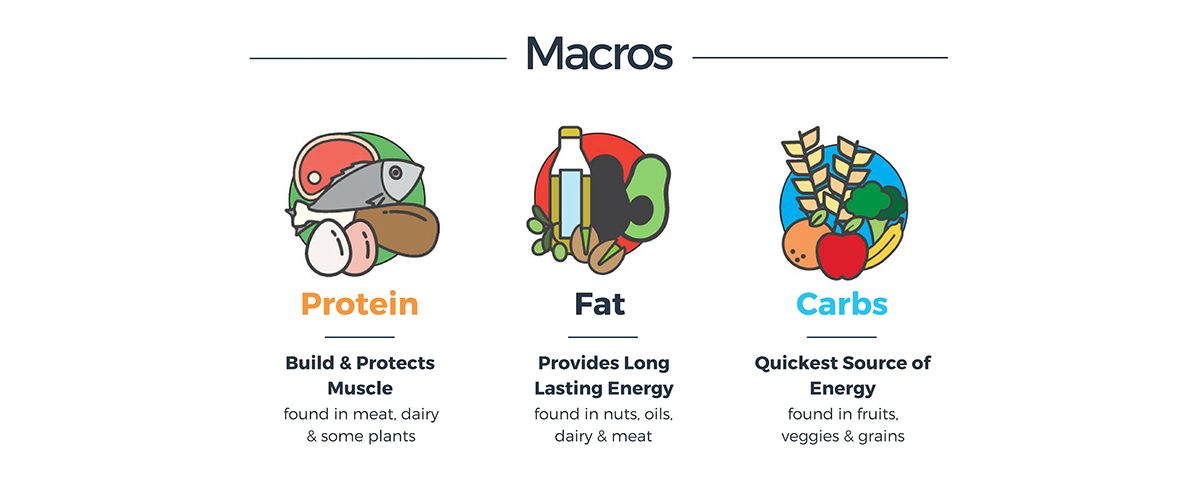
Generally, macronutrients are broken into three groups: carbohydrates, protein, and fat. Alcohol is also considered a macro since it provides calories, but it is not a considered an important source of nutrition, so it is often left out when counting macros.
Each macro provides a different calorie amount per gram – 4 grams per calorie for protein and carbs, and 9 grams of calories for fat (alcohol provides 7 grams per calorie). And even though all macros provide valuable energy, each macro has a different function in your body.
Because macros are essentially your calories organized into key groups, learning how to balance and track your macros is a popular approach to weight loss and better fitness results.
Carbohydrates
We use carbohydrates for quick energy – they are your body’s favorite source of fuel because it doesn’t take a lot of work to get energy from carbs. Our bodies easily break down this macronutrient into glucose (sugar) which is the same type of sugar found in your blood. Our brains and muscles are the biggest users of glucose, but all cells in our bodies use it to function. But the amount of carbs you need each day can differ from one person to the next based on activity level, weight, muscle mass, overall health, etc.
However, carbs are not essential for survival. Your body has a work-around when carbs are not present for extended periods of time, or possibly forever, using fat and protein instead. This is how the keto diet works!
In addition, not all carbs are created equal. Carbs come from all plant based foods and some dairy, but they can also come from directly from added sugar and many processed, unhealthy foods. Because carbs are so easy to get in the diet, they can tend to get a bad rap. But choosing more wholesome sources include whole grains, fruits and vegetables, and beans, can improve your overall nutrition and allow you to still be successful in losing weight.
Sugar
All carbs are technically a type of sugar, but not all of them act the same way when it comes to your health. Naturally occurring sugar – like the kind found in fruits, milk and legumes, is often confused with added sugar. Sugar from whole foods tend to be combined with other key nutrients and don;t always cause a spike in blood sugar. Whereas added sugar tends to be found in mostly processed foods, and when eaten alone (like in a sugar sweetened soda) can certainly impact your energy and insulin levels more drastically than other carbs.
By rule of thumb, you should aim to limit added sugars and focus on more naturally occurring sources from plant based foods.
Starch
Starchy carbs are often referred to as “complex carbs”. This type of carb takes the longest to break down, providing more sustained energy and less impact on your blood sugar levels. Common starchy foods include corn, beans, potatoes and whole grains.
Fiber
And lastly fiber! Many people don’t realize that fiber is actually a type of carbohydrate. But fiber is not as easily digested, and cannot be absorbed by the body, making it significantly different than other carb types. There are two main types of fiber, soluble fiber that helps draw water into your gut, aiding in feelings of fullness and promoting heart health (as it draws water in, it can also grab cholesterol among other things with it). And insoluble fiber that sort of pushes everything through, supporting digestion and regularity.
The best sources of fiber include whole grains, beans, nuts, seeds, fruits and vegetables.
Protein
Protein is the “builder” macro and unlike carbs, it is essential for good nutrition. In fact, protein plays such a unique role, it is often your last resort for daily energy and instead used to build, repair and maintain your entire self.
We need protein in our diets because it provides us with essential amino acids that we cannot make ourselves. Our bodies are like recycling geniuses that can take an old pallet (plant and animal protein), break it down (into amino acids), and make a bench from the parts (new protein). Proteins play a part in all of our bodies’ functions from our nervous system to our digestive system, and our entire body, cells, DNA, etc. is all made up of proteins.
Healthy sources include beans, nuts and seeds, lean meats, and eggs. And while animal sources of protein have the highest protein content per calorie, you can also meet your protein needs without eating animal products on a vegan or vegetarian diet.
Fat
Fats, like protein, are also an essential dietary must – they are a great long-term source of energy and also play a vital role in maintaining healthy skin and hair, insulating body organs against shock, maintaining body temperature, hormone regulation, and promoting healthy cell function.
Fat tends to get a bad rap because it is the most calorie dense macro (providing more calories per volume) and when eaten in excess it can easily stored as body fat. But other macros can also be stored as body fat and this process requires you to eat more calories than you need – leading to weight gain. There is no need to fear fat as long as your calories are controlled and you are using an overall macro balance that works for you.
Healthy sources of fat include eggs, fatty fish, nuts and seeds, healthy oils, and avocados.
Saturated Fat
It is highly debated whether saturated fats are needed, but it is widely agreed we should not consume them in high amounts. While the research is torn over whether or not they are 100% “bad”, high intakes of saturated fat has been associated with increased blood cholesterol in numerous studies and we haven’t found in true health benefits of this type of fat either .
Saturated fats are mostly found in animal products like milk, cheese, and meats, but they are also found in smaller amounts in plant sources such as seeds and nuts, avocados, and plant oils.
Cholesterol
Cholesterol is a type of fat used to make hormones, Vitamin D, and digestive substances. But it is not necessary to consume high amounts of cholesterol because our bodies can make it from the fat we eat. Research has also indicated that dietary cholesterol may not be as strongly linked to blood cholesterol as we once though, but it is probably still good practice to avoid going overboard .
Major dietary sources of cholesterol include cheese, egg yolks, and fatty meats. It is not found in significant amounts in plant sources.
Micronutrients are one of the major groups of nutrients your body needs. They include vitamins and minerals.
Vitamins are necessary for energy production, immune function, blood clotting and other functions. Meanwhile, minerals play an important role in growth, bone health, fluid balance and several other processes.
This article provides a detailed overview of micronutrients, their functions and implications of excess consumption or deficiency.
What Are Micronutrients?
The term micronutrients is used to describe vitamins and minerals in general.
Macronutrients, on the other hand, include proteins, fats and carbohydrates.
Your body needs smaller amounts of micronutrients relative to macronutrients. That’s why they’re labeled “micro.”
Humans must obtain micronutrients from food since your body cannot produce vitamins and minerals — for the most part. That’s why they’re also referred to as essential nutrients.
Vitamins are organic compounds made by plants and animals which can be broken down by heat, acid or air. On the other hand, minerals are inorganic, exist in soil or water and cannot be broken down.
When you eat, you consume the vitamins that plants and animals created or the minerals they absorbed.
The micronutrient content of each food is different, so it’s best to eat a variety of foods to get enough vitamins and minerals.
An adequate intake of all micronutrients is necessary for optimal health, as each vitamin and mineral has a specific role in your body.
Vitamins and minerals are vital for growth, immune function, brain development and many other important functions.
Depending on their function, certain micronutrients also play a role in preventing and fighting disease
Summary
Micronutrients include vitamins and minerals. They’re critical for several important functions in your body and must be consumed from food.
Types and Functions of Micronutrients
Vitamins and minerals can be divided into four categories: water-soluble vitamins, fat-soluble vitamins, macrominerals and trace minerals.
Regardless of type, vitamins and minerals are absorbed in similar ways in your body and interact in many processes.
Water-Soluble Vitamins
Most vitamins dissolve in water and are therefore known as water-soluble. They’re not easily stored in your body and get flushed out with urine when consumed in excess.
While each water-soluble vitamin has a unique role, their functions are related.
For example, most B vitamins act as coenzymes that help trigger important chemical reactions. A lot of these reactions are necessary for energy production.
The water-soluble vitamins — with some of their functions — are:
- Vitamin B1 (thiamine): Helps convert nutrients into energy.
- Vitamin B2 (riboflavin): Necessary for energy production, cell function and fat metabolism.
- Vitamin B3 (niacin): Drives the production of energy from food.
- Vitamin B5 (pantothenic acid): Necessary for fatty acid synthesis .
- Vitamin B6 (pyridoxine): Helps your body release sugar from stored carbohydrates for energy and create red blood cells .
- Vitamin B7 (biotin): Plays a role in the metabolism of fatty acids, amino acids and glucose .
- Vitamin B9 (folate): Important for proper cell division .
- Vitamin B12 (cobalamin): Necessary for red blood cell formation and proper nervous system and brain function
- Vitamin C (ascorbic acid): Required for the creation of neurotransmitters and collagen, the main protein in your skin.
As you can see, water-soluble vitamins play an important role in producing energy but also have several other functions.
Since these vitamins are not stored in your body, it’s important to get enough of them from food.
REQUEST AN APPOINTMENT OR BOOK A CONSULANT – Sargam.dange.18@gmail.com
Sources and Recommended Dietary Allowances (RDAs) or Adequate Intakes (AIs) of water-soluble vitamins are
| Nutrient | Sources | RDA or AI (adults > 19 years) |
| Vitamin B1 (thiamine) | Whole grains, meat, fish | 1.1–1.2 mg |
| Vitamin B2 (riboflavin) | Organ meats, eggs, milk | 1.1–1.3 mg |
| Vitamin B3 (niacin) | Meat, salmon, leafy greens, beans | 14–16 mg |
| Vitamin B5 (pantothenic acid) | Organ meats, mushrooms, tuna, avocado | 5 mg |
| Vitamin B6 (pyridoxine) | Fish, milk, carrots, potatoes | 1.3 mg |
| Vitamin B7 (biotin) | Eggs, almonds, spinach, sweet potatoes | 30 mcg |
| Vitamin B9 (folate) | Beef, liver, black-eyed peas, spinach, asparagus | 400 mg |
| Vitamin B12 (cobalamin) | Clams, fish, meat | 2.4 mcg |
| Vitamin C (ascorbic acid) | Citrus fruits, bell peppers, Brussels sprouts | 75–90 mg |
Fat-Soluble Vitamins
Fat-soluble vitamins do not dissolve in water.
They’re best absorbed when consumed alongside a source of fat. After consumption, fat-soluble vitamins are stored in your liver and fatty tissues for future use.
The names and functions of fat-soluble vitamins are:
- Vitamin A: Necessary for proper vision and organ function .
- Vitamin D: Promotes proper immune function and assists in calcium absorption and bone growth.
- Vitamin E: Assists immune function and acts as an antioxidant that protects cells from damage.
- Vitamin K: Required for blood clotting and proper bone development.
Sources and recommended intakes of fat-soluble vitamins are:
| Nutrient | Sources | RDA or AI (adults > 19 years) |
| Vitamin A | Retinol (liver, dairy, fish), carotenoids (sweet potatoes, carrots, spinach) | 700–900 mcg |
| Vitamin D | Sunlight, fish oil, milk | 600–800 IU |
| Vitamin E | Sunflower seeds, wheat germ, almonds | 15 mg |
| Vitamin K | Leafy greens, soybeans, pumpkin | 90–120 mcg |
Macrominerals
Macrominerals are needed in larger amounts than trace minerals in order to perform their specific roles in your body.
The macrominerals and some of their functions are:
- Calcium: Necessary for proper structure and function of bones and teeth. Assists in muscle function and blood vessel contraction.
- Phosphorus: Part of bone and cell membrane structure.
- Magnesium: Assists with over 300 enzyme reactions, including regulation of blood pressure.
- Sodium: Electrolyte that aids fluid balance and maintenance of blood pressure
- Chloride: Often found in combination with sodium. Helps maintain fluid balance and is used to make digestive juices.
- Potassium: Electrolyte that maintains fluid status in cells and helps with nerve transmission and muscle function .
- Sulfur: Part of every living tissue and contained in the amino acids methionine and cysteine
Sources and recommended intakes of the macrominerals are
| Nutrient | Sources | RDA or AI (adults > 19 years) |
| Calcium | Milk products, leafy greens, broccoli | 2,000–2,500 mg |
| Phosphorus | Salmon, yogurt, turkey | 700 mg |
| Magnesium | Almonds, cashews, black beans | 310–420 mg |
| Sodium | Salt, processed foods, canned soup | 2,300 mg |
| Chloride | Seaweed, salt, celery | 1,800–2,300 mg |
| Potassium | Lentils, acorn squash, bananas | 4,700 mg |
| Sulfur | Garlic, onions, Brussels sprouts, eggs, mineral water | None established |
Trace Minerals
Trace minerals are needed in smaller amounts than macrominerals but still enable important functions in your body.
The trace minerals and some of their functions are:
- Iron: Helps provide oxygen to muscles and assists in the creation of certain hormones.
- Manganese: Assists in carbohydrate, amino acid and cholesterol metabolism.
- Copper: Required for connective tissue formation, as well as normal brain and nervous system function .
- Zinc: Necessary for normal growth, immune function and wound healing.
- Iodine: Assists in thyroid regulation.
- Fluoride: Necessary for the development of bones and teeth.
- Selenium: Important for thyroid health, reproduction and defense against oxidative damage .
Sources and recommended intakes of trace minerals are:
| Nutrient | Sources | RDA or AI (adults > 19 years) |
| Iron | Oysters, white beans, spinach | 8–18 mg |
| Manganese | Pineapple, pecans, peanuts | 1.8–2.3 mg |
| Copper | Liver, crabs, cashews | 900 mcg |
| Zinc | Oysters, crab, chickpeas | 8–11 mg |
| Iodine | Seaweed, cod, yogurt | 150 mcg |
| Fluoride | Fruit juice, water, crab | 3–4 mg |
| Selenium | Brazil nuts, sardines, ham | 55 mcg |
Summary
Micronutrients can be divided into four groups — water-soluble vitamins, fat-soluble vitamins, macrominerals and trace minerals. The functions, food sources and recommended intakes of each vitamin and mineral vary.
Health Benefits of Micronutrients
All micronutrients are extremely important for the proper functioning of your body.
Consuming an adequate amount of the different vitamins and minerals is key to optimal health and may even help fight disease.
This is because micronutrients are part of nearly every process in your body. Moreover, certain vitamins and minerals can act as antioxidants.
Antioxidants may protect against cell damage that has been associated with certain diseases, including cancer, Alzheimer’s and heart disease
For example, research has linked an adequate dietary intake of vitamins A and C with a lower risk of some types of cancer
Getting enough of some vitamins may also help prevent Alzheimer’s disease. A review of seven studies found that adequate dietary intake of vitamins E, C and A is associated with a 24%, 17% and 12% reduced risk of developing Alzheimer’s, respectively .
Certain minerals may also play a role in preventing and fighting disease.
Research has linked low blood levels of selenium to a higher risk of heart disease. A review of observational studies found that the risk of heart disease decreased by 24% when blood concentrations of selenium increased by 50%.
Additionally, a review of 22 studies noticed that adequate calcium intake decreases the risk of death from heart disease and all other causes.
These studies suggest that consuming enough of all micronutrients — especially those with antioxidant properties — provides ample health benefits.
However, it’s unclear whether consuming more than the recommended amounts of certain micronutrients — either from foods or supplements — offers additional benefits
Summary
Micronutrients are part of nearly every process in your body. Some even act as antioxidants. Due to their important role in health, they may protect against diseases.
Micronutrient Deficiencies and Toxicities
Micronutrients are needed in specific amounts to perform their unique functions in your body.
Getting too much or too little of a vitamin or mineral can lead to negative side effects.
Deficiencies
Most healthy adults can get an adequate amount of micronutrients from a balanced diet, but there are some common nutrient deficiencies that affect certain populations.
These include:
- Vitamin D: Approximately 77% of Americans are deficient in vitamin D, mostly due to lack of sun exposure.
- Vitamin B12: Vegans and vegetarians may develop vitamin B12 deficiency from refraining from animal products. Elderly individuals are also at risk due to decreased absorption with age.
- Vitamin A: The diets of women and children in developing countries often lack adequate vitamin A.
- Iron: Deficiency of this mineral is common among preschool children, menstruating women and vegans .
- Calcium: Close to 22% and 10% of men and women over 50, respectively, don’t get enough calcium.
The signs, symptoms and long-term effects of these deficiencies depend on each nutrient but can be detrimental to the proper functioning of your body and optimal health.
Toxicities
Micronutrient toxicities are less common than deficiencies.
They are most likely to occur with large doses of the fat-soluble vitamins A, D, E and K since these nutrients can be stored in your liver and fatty tissues. They cannot be excreted from your body like water-soluble vitamins.
A micronutrient toxicity usually develops from supplementing with excess amounts — rarely from food sources. Signs and symptoms of toxicity vary depending on the nutrient.
It’s important to note that excessive consumption of certain nutrients can still be dangerous even if it does not lead to overt toxicity symptoms.
One study examined over 18,000 people with a high risk of lung cancer due to past smoking or asbestos exposure. The intervention group received two types of vitamin A — 30 mg of beta-carotene and 25,000 IU of retinyl palmitate a day .
The trial was halted ahead of schedule when the intervention group showed 28% more cases of lung cancer and a 17% greater incidence of death over 11 years compared to the control group.
Micronutrient Supplements
The safest and most effective way to get adequate vitamin and mineral intake appears to be from food sources.
More research is needed to fully understand the long-term effects of toxicities and supplements.
However, people at risk of specific nutrient deficiencies may benefit from taking supplements under the supervision of a doctor.
If you’re interested in taking micronutrient supplements, look for products certified by a third party. Unless otherwise directed by a healthcare provider, be sure to avoid products that contain “super” or “mega” doses of any nutrient.
REQUEST AN APPOINTMENT OR BOOK A CONSULANT – Sargam.dange.18@gmail.com
 Medicurio