REQUEST AN APPOINTMENT OR BOOK A CONSULANT – Sargam.dange.18@gmail.com
Learning involves a change in behavior or knowledge that results from experience.
The word learning is used routinely in discussions about teaching in higher education, so it’s important to clarify what we are referring to when we talk about learning. Educational researchers agree that learning is much deeper than memorization and information recall. Deep and long-lasting learning involves understanding, relating ideas and making connections between prior and new knowledge, independent and critical thinking and ability to transfer knowledge to new and different contexts.
Psychologists often define learning as a relatively permanent change in behavior as a result of experience. The psychology of learning focuses on a range of topics related to how people learn and interact with their environments.
One of the first thinkers to study how learning influences behavior was psychologist John B. Watson who suggested that all behaviors are a result of the learning process. The school of thought that emerged from Watson’s work was known as behaviorism. The behavioral school of thought proposed studying internal thoughts, memories, and other mental processes that were too subjective.
Psychology, the behaviorists believed, should be the scientific study of observable behavior. Behaviorism thrived during the first half of the twentieth century and contributed a great deal to our understanding of some important learning processes.
Are you preparing for a big test in your psychology of learning class? Or are you just interested in a review of learning and behavioral psychology topics? This learning study guide offers a brief overview of some of the major learning issues including behaviorism, classical, and operant conditioning.

Let’s learn a bit more about the psychology of learning.
Learning
Learning can be defined in many ways, but most psychologists would agree that it is a relatively permanent change in behavior that results from experience. During the first half of the twentieth century, the school of thought known as behaviorism rose to dominate psychology and sought to explain the learning process.
The three major types of learning described by behavioral psychology are classical conditioning, operant conditioning, and observational learning.
Behaviorism
Behaviorism was the school of thought in psychology that sought to measure only observable behaviors.
Founded by John B. Watson and outlined in his seminal 1913 paper Psychology as the Behaviorist Views It, the behaviorist standpoint held that psychology was an experimental and objective science and that internal mental processes should not be considered because they could not be directly observed and measured.
Watson’s work included the famous Little Albert experiment in which he conditioned a small child to fear a white rat. Behaviorism dominated psychology for much of the early twentieth century. While behavioral approaches remain important today, the latter part of the century was marked by the emergence of humanistic psychology, biological psychology, and cognitive psychology.
Types of Learning
There are three main types of learning: classical conditioning, operant conditioning, and observational learning. Both classical and operant conditioning are forms of associative learning, in which associations are made between events that occur together. Observational learning is just as it sounds: learning by observing others.
Classical Conditioning
Classical conditioning is a process by which we learn to associate events, or stimuli, that frequently happen together; as a result of this, we learn to anticipate events. Ivan Pavlov conducted a famous study involving dogs in which he trained (or conditioned) the dogs to associate the sound of a bell with the presence of a piece of meat. The conditioning is achieved when the sound of the bell on its own makes the dog salivate in anticipation for the meat.
Imagine your favorite snack is peanut butter and jelly sandwiches. Whenever you get that snack, it makes you happy and you start to jump around, doing your happy PB&J dance. Your sandwich always comes on the same plate – it’s big and orange and has a picture of a tiger on it. Eventually, you might start doing your PB&J dance whenever you see your tiger plate on the table, in anticipation of the sandwich arriving.
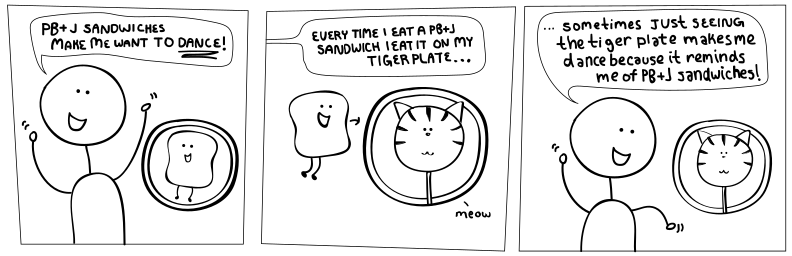
Cartoon explaining what classical conditioning is. This type of conditioning is called classical conditioning. The presence of the plate has caused you to have the same reaction as having a PB&J sandwich. The sandwich is our stimulus (the unconditioned stimulus) and it elicits the dance which is our response (the unconditioned response). “Unconditioned” refers to the fact that no learning took place to connect the stimulus and response – you saw the the sandwich and automatically got so excited you start to dance (like a reflex!).
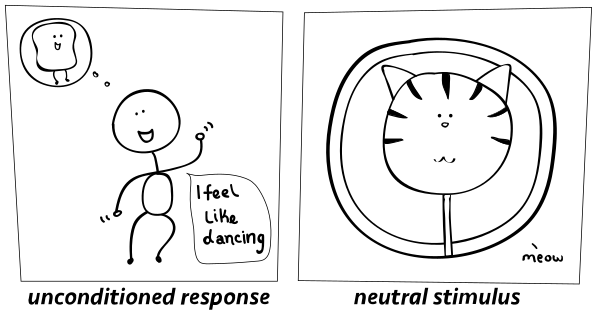
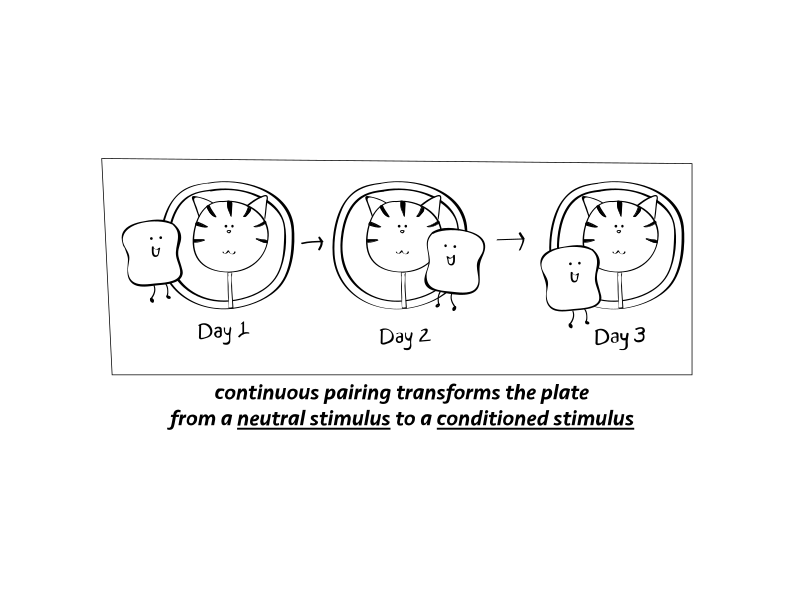
Cartoon explaining what an unconditioned response is as well as a neutral stimulus. The plate starts off as a neutral stimulus and elicits no reaction on its own. As it is continuously paired with the sandwich, the plate becomes a conditioned stimulus and elicits a conditioned response in the form of your happy dance. Over time, you have learned to connect the plate and the feelings of happiness that cause you to dance.
REQUEST AN APPOINTMENT OR BOOK A CONSULANT – Sargam.dange.18@gmail.com
Cartoon showing how the tiger plate turns from a neutral stimulus to a conditioned stimulus over time. Also interesting to think about is just why it is you dance when you see that sandwich in the first place. Earlier, we stated that it is was the unconditioned stimulus because it took no learning to cause you to dance at the sight of it. At the start of our thought experiment, that was true. However, when you were first introduced to PB&J, you would dance while eating it because it tasted so good. Eventually, an association between sight and taste formed (learned via classical conditioning) and you began to dance preemptively – just the sight was enough to trigger the feelings of joy expressed by the dance.. If we really follow this line of thought about our everyday actions, we’ll find that many, if not most, of our actions can be traced back to pretty basic needs like food, shelter, comfort, etc.
Operant Conditioning
Operant conditioning is the learning process by which behaviors are reinforced or punished, thus strengthening or extinguishing a response. Edward Thorndike coined the term “law of effect,” in which behaviors that are followed by consequences that are satisfying to the organism are more likely to be repeated, and behaviors that are followed by unpleasant consequences are less likely to be repeated. B. F. Skinner researched operant conditioning by conducting experiments with rats in what he called a “Skinner box.” Over time, the rats learned that stepping on the lever directly caused the release of food, demonstrating that behavior can be influenced by rewards or punishments. He differentiated between positive and negative reinforcement, and also explored the concept of extinction.
In classical conditioning, the stimuli that precede a behavior will vary (PB&J sandwich, then tiger plate), to alter that behavior(e.g. dancing with the tiger plate!). In operant conditioning, the consequences which come after a behavior will vary, to alter that behavior. Imagine years down the road you are still enamored of delicious PB&J sandwiches, and now are trying to teach yourself to be a good roommate. The house rule is that whoever leaves their dishes unwashed the longest has to take out the trash. You hate taking out the trash, so you develop a system – whenever you remember to wash your plate, you are allowed to surf the internet, otherwise you’re not allowed. The more dishes you wash, the more you get to procrastinate on your favorite sites. Initially, you leave the plate in the sink a few times, then you begin to remember after a day or so, and finally you start to wash your dishes immediately after using them. This process of shaping involves intermediate behaviors (leaving the plate in the sink and beginning to come back to wash the dishes within hours) that start moving you towards the goal behavior (washing your dishes immediately).
Observational Learning
Observational learning occurs through observing the behaviors of others and imitating those behaviors—even if there is no reinforcement at the time. Albert Bandura noticed that children often learn through imitating adults, and he tested his theory using his famous Bobo-doll experiment. Through this experiment, Bandura learned that children would attack the Bobo doll after viewing adults hitting the doll.
How do we influence behavior?
Operant conditioning changes behaviors by using consequences, and these consequences will have two characteristics:
- Reinforcement or punishment
–Reinforcement is a response or consequence that causes a behavior to occur with greater frequency.-Punishment is a response or consequence that causes a behavior to occur with less frequency.
- Positive or negative
–Positive means adding a new stimulus.-Negative means removing an old stimulus. There end up being 4 different ways we can affect behavior with operant conditioning:
| negative reinforcement | – | positive reinforcement | |
| negative punishment | – | positive punishment |
Let’s go back to our example of washing the dishes, and consider the four different types of operant conditioning based consequences. If you leave the dish on the table instead of washing it, some sort of punishment will happen because this is an undesired behavior.
- Positive punishment: You will get a new chore such as sweeping the floors! (adding a new stimulus).
- Negative punishment: You will not get to eat the usual apple pie dessert (removing an old stimulus)
If you remember to wash your plate, some sort of reinforcement will happen because this is a desired behavior.
- Positive reinforcement: You will get to make one online purchase! (adding a new stimulus).
- Negative reinforcement: You won’t have to take out the trash this week, a standard chore (removing an old stimulus).
How effective is the conditioning?
Imagine your tiger plate was one of a set of plates – jungle cat plates. There is a lion, a jaguar, and a leopard as well
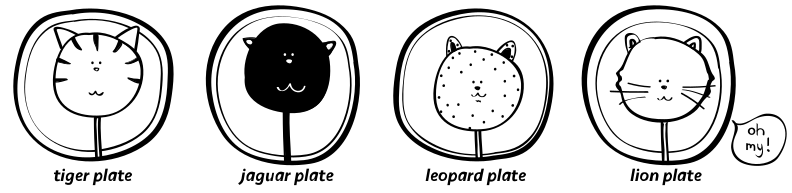
Cartoon showing the different types of animal plates in the set.They’re all generally the same shape and color, so you react to these plates the same way you reacted to the tiger plate, (the original conditioned stimulus) and do your happy dance. We call this generalization – when a conditioned response (happy dance) occurs in reaction to a stimulus (jungle cat plates) other than (but often similar to) the conditioned one (tiger plate). A good way to remember is that now you do a happy dance for cat plates in general. The opposite of generalization is discrimination – the ability to tell different stimuli apart and react only to certain ones. You show discrimination whenever you don’t dance because you can tell the difference between the peanut butter and the pickle jars, for example, or by dancing only at snack time, since you know that’s the only time the PB&J happens. Imagine that you’ve run out of peanut butter, so you’re stuck with tuna salad for weeks (oh no!). Your parents try to make it better by serving it on your favorite tiger plate, but you soon realize the tiger plate does not mean PB&J. You lose the association between the tiger plate and PB&J, and stop doing your happy dance whenever you see that plate. We call this extinction – your conditioned response (happy dance) disappeared. However, when peanut butter in your house again and your parents serve you PB&J on your tiger plate, the previous association between the tiger plate and PB&J dance quickly will come back in full force. We call this spontaneous recovery.While the discussion above focused on our examples from classical conditioning, the same concepts can be applied to operant conditioning as well. Maybe your chore scheme works so well you begin to wipe down the kitchen counters whenever you make a big meal, or you refuse to allow yourself pie if you haven’t folded your laundry.
What are examples of conditioning in your daily life?
Conditioning, both classical and operant, can be seen throughout our daily lives. Insurance companies will charge you more if you keep getting into accidents (negative punishment) or give you congratulatory certificates for safer driving (positive reinforcement). When driving, seeing flashing lights in your rearview mirror coupled with a siren will cause a gut feeling of dread even before the officer comes by with your ticket. Maybe it’s not even you they’re pulling over, but those signals (conditioned stimuli) are so associated with tickets and fines (unconditioned stimuli) that you can feel it in your stomach (conditioned response). Now that we’ve explored conditioning some, be on the lookout for examples in your day to day life, and maybe even consider using some of those techniques on yourself – for every hour and a half of studying, give yourself a ten minute break to stretch and watch funny videos or walk around!

Key Points
- Learning involves physical changes in the nervous system, such as the strengthening of synapses, the activation of neural pathways, or the pruning of neural pathways. These changes elicit specific responses to environmental stimuli.
- The field of behavioral psychology focuses largely on measurable behaviors that are learned, rather than trying to understand internal states such as emotions and attitudes.
- Types of learning include classical and operant conditioning (both forms of associative learning) as well as observational learning.
- Classical conditioning, initially described by Ivan Pavlov, occurs when a particular response to a stimulus becomes conditioned to respond to another associated stimulus.
- Operant conditioning, initially described by B. F. Skinner, is the learning process by which a response is strengthened or extinguished through the reinforcement or punishment of a behavior.
- Observational learning, initially described by Albert Bandura, occurs through observing the behaviors of others and imitating those behaviors, even if there is no reinforcement at the time.
REQUEST AN APPOINTMENT OR BOOK A CONSULANT – Sargam.dange.18@gmail.com
 Medicurio